

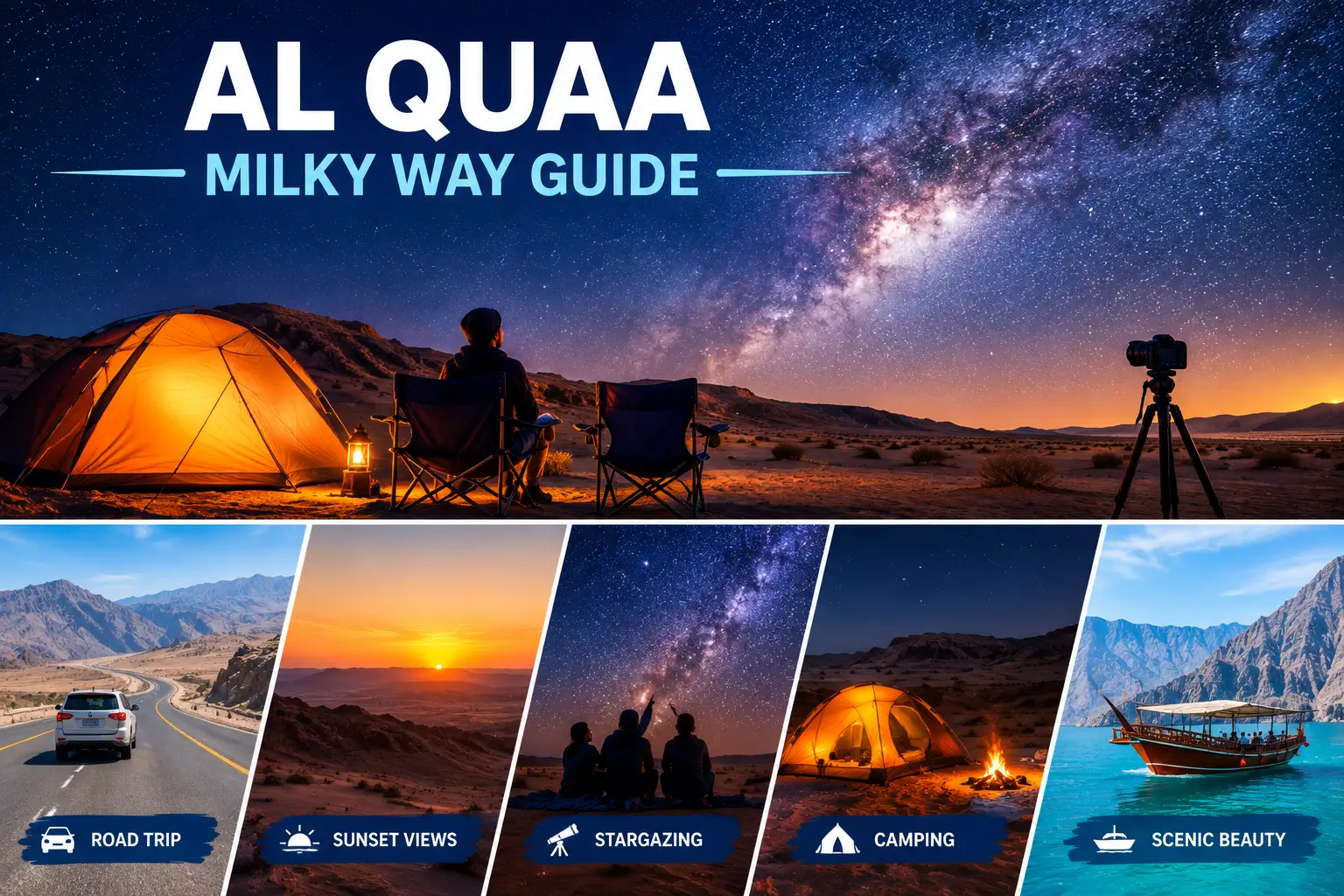
If you have ever looked at photographs of the Milky Way stretching across a completely dark desert sky, you may wonder where you can experience something similar in the UAE. One of the most popular places for this experience is Al Quaa, a remote desert location in Abu Dhabi known for its exceptionally dark skies and limited light pollution.
Away from the bright lights of Abu Dhabi and other major urban areas, Al Quaa offers a very different side of the UAE. Instead of skyscrapers, busy roads, and city lights, visitors find wide desert landscapes, quiet surroundings, and a sky filled with stars. On a suitable night, the Milky Way can become clearly visible, making the area especially attractive to photographers, astronomy enthusiasts, campers, and travellers looking for a peaceful desert experience.
This Al Quaa Milky Way guide explains what makes the location special, the best time to visit, how to prepare for a stargazing trip, what you can expect after sunset, and the important things to know before heading into the desert.
What Is Al Quaa Milky Way Spot?
Al Quaa is a remote desert area in the Abu Dhabi emirate that has become widely known as one of the UAE’s most impressive dark-sky destinations. Its distance from major sources of artificial light makes it possible to see far more stars than you would normally see from a city.
The location is particularly popular among people interested in Milky Way photography. When the weather is clear and the moon is not bright enough to wash out the sky, the contrast between the dark desert and the stars can be remarkable.
The experience is not really about visiting a conventional tourist attraction with buildings, shops, or entertainment facilities. The sky itself is the attraction. You travel into the desert, find a suitable viewing point, settle down, and wait for darkness to reveal the night sky. Al Quaa Milky Way Spot is currently listed as a tourist attraction and campground in Abu Dhabi.
Why Is Al Quaa Famous for Stargazing?
The biggest reason is simple: light pollution. Artificial light from cities can make it difficult to see faint stars and deep-sky objects. Even if the sky is clear, the glow from buildings, roads, and surrounding developments can reduce visibility.
Al Quaa is much farther away from major urban lighting. This creates a darker environment where the night sky becomes much more impressive. Experience Abu Dhabi also highlights the importance of getting away from city lights when enjoying desert stargazing, noting that remote desert environments can reveal constellations, planets, and wide stretches of stars after dark.
For many visitors, the difference becomes obvious within minutes of arriving. As the remaining daylight disappears, individual stars begin appearing across the sky. Later in the night, under favourable conditions, the Milky Way can become one of the most noticeable features overhead. This is why Al Quaa has become especially popular for photographers who want to capture the Milky Way without the orange glow commonly visible around cities.
Where Is Al Quaa Located?
Al Quaa is located in the Abu Dhabi emirate, deep in the desert and roughly southeast of Abu Dhabi city. It is also relatively close to the Al Ain side of the UAE compared with central Abu Dhabi. The exact journey depends on your starting point, route, road conditions, and the specific stargazing location you choose. If you are travelling independently, it is important to plan your route before leaving because this is a remote desert environment rather than a developed sightseeing district.
Do not rely completely on mobile data once you are far from populated areas. Download your maps and important information before starting the journey, and make sure your vehicle has enough fuel and water.
What Makes Al Quaa Different From City Stargazing?
Stargazing from a city rooftop and stargazing in Al Quaa are two very different experiences. In Abu Dhabi or Dubai, you may be able to see the Moon, some bright planets, and a limited number of stars. However, surrounding lights can make the sky appear much brighter than it actually is.
At Al Quaa, the environment is much darker. There are fewer distractions, less artificial light, and a much wider horizon. The desert also creates a sense of space that makes the experience feel more immersive. You are not simply looking upward for a few minutes. You sit in a quiet desert landscape and let your eyes adjust naturally to the darkness. That atmosphere is one of the main reasons people return to Al Quaa even after their first visit.
Best Time to See the Milky Way at Al Quaa
Choosing the right night is one of the most important parts of planning an Al Quaa Milky Way trip. The Milky Way isn’t equally visible year-round. Its appearance changes depending on the season, time of night, your viewing direction, and your location. The galactic core is especially important for the dramatic Milky Way photographs commonly associated with desert stargazing.
For the best chance of seeing a strong Milky Way, look for a night when the sky is clear and there is little or no moonlight. A new-moon period is generally preferred by astrophotographers because a bright Moon can make the sky appear lighter and reduce the visibility of fainter stars.
The Milky Way season is commonly associated with the warmer months in the UAE, although the exact visibility of the galactic core changes throughout the year. Some current Al Quaa guides describe March to October as the main Milky Way season, while other astronomy-focused guides use a narrower peak period. The safest approach is to check an astronomy or stargazing forecast for your exact date rather than relying only on a fixed month range.
The good news is that stargazing itself is possible throughout the year. Even when the Milky Way’s most prominent section is not in the best position, you can still enjoy stars, constellations, planets, and the peaceful desert night.
Does the Moon Affect Al Quaa Stargazing?
Yes, significantly. The Moon is beautiful to watch, but a bright Moon can make it harder to see faint stars. Its light illuminates the surrounding landscape and reduces the contrast between the night sky and celestial objects.
If your main goal is Milky Way photography, a night close to the new moon is generally preferable. If your goal is simply to enjoy the desert night sky, the Moon does not necessarily make the trip a bad idea. In fact, a moonlit desert can create a completely different atmosphere. You may see the dunes and landscape more clearly, although the number of visible stars will usually be lower. Before travelling, check the moon phase, moonrise, and moonset times for your planned date.
What Can You See in the Al Quaa Night Sky?
On a clear night, the sky can offer much more than just the Milky Way. Depending on the season and conditions, you may see numerous constellations, bright stars, planets, shooting stars, and other celestial features. The exact objects visible will change throughout the year. One of the most enjoyable parts of the experience is allowing your eyes several minutes to adjust to the darkness. When you first arrive, the sky may appear relatively ordinary. After your eyes adapt, more and more stars become visible.
For astronomy enthusiasts, binoculars or a telescope can make the experience even more interesting. However, you do not need expensive equipment to enjoy Al Quaa. Simply sitting outside away from artificial light can provide a memorable experience.
Al Quaa for Milky Way Photography
Al Quaa is particularly attractive to photography enthusiasts because dark skies provide better conditions for capturing the Milky Way. A modern smartphone can capture stars under favourable conditions, but a dedicated camera with manual controls generally provides greater flexibility. A wide-angle lens, tripod, remote shutter or timer, and manual focus can make a significant difference.
The most important preparation is not necessarily the camera. It is the location and the conditions. A clear sky, low humidity, minimal moonlight, and darkness are all important. Dust, clouds, haze, and atmospheric conditions can affect the final photograph.
Photographers should also remember that desert conditions can be challenging for equipment. Keep cameras and lenses protected from blowing sand, avoid changing lenses unnecessarily in dusty conditions, and bring spare batteries because long-exposure photography can consume power quickly.
What Is an Al Quaa Stargazing Experience Like?
A typical Al Quaa evening starts before complete darkness. Arriving around sunset gives you an opportunity to experience the desert during daylight rather than reaching the location after everything is already dark. The changing colours of the sand can be beautiful, and having daylight also makes it easier to set up your camping or photography equipment. As evening arrives, the temperature begins to change and the desert becomes quieter. Once artificial light is minimised and darkness takes over, the focus naturally shifts toward the sky.
Some organised experiences include desert camping, dinner, refreshments, a campfire, astronomy guidance, telescopes, or photography assistance. Other visitors choose to drive independently and create a simpler experience with their own camping equipment. The exact facilities and inclusions depend on the experience you choose, so it is important to check what is actually included before booking.
Should You Visit Al Quaa for One Night or Overnight Camping?
Both options can work. A shorter evening visit is suitable if your main purpose is to photograph the Milky Way or spend a few hours under the stars. You can enjoy sunset, wait for the sky to become dark, spend time stargazing, and then return. An overnight stay gives you more time to experience the desert. You can enjoy sunset, dinner, several hours of stargazing, and then wake up to sunrise.
Current organised Al Quaa experiences include both night tours and overnight desert camping options, showing how the location is commonly used for extended desert experiences rather than only short visits. For first-time visitors, an organised overnight experience can also be more convenient because transport, camping arrangements, food, and other practical details may be handled by the operator.
What Should You Carry to Al Quaa?
Because Al Quaa is remote, preparation matters. Water should be one of your highest priorities. Carry more than you think you will need, particularly if you are travelling during warmer weather. You should also consider warm clothing for the night, even if the afternoon feels hot. Desert temperatures can drop after sunset, and sitting outside for several hours can feel much colder than expected.
A flashlight or headlamp is useful, but choose a model with a red-light mode if possible. Bright white lights can interfere with your own night vision and disturb other people who are trying to photograph or observe the sky.
Other useful items include a power bank, fully charged phone, offline maps, comfortable shoes, basic food or snacks, a blanket or camping chair, and any photography equipment you plan to use. If you are camping independently, your preparation needs to be considerably more comprehensive because there may not be convenient facilities nearby.
Is There Mobile Network at Al Quaa?
Mobile connectivity can be less reliable in remote desert areas than it is in Abu Dhabi city. That does not mean your phone will definitely stop working, but you should not plan your trip assuming you will always have a strong data connection.
Download maps, directions, booking confirmations, emergency information, and any astronomy applications you plan to use before leaving the city. It is also sensible to tell someone about your route if you are travelling independently.
Is Al Quaa Suitable for Families?
Yes, provided the trip is planned properly. Children who enjoy nature, photography, camping, or astronomy can find the experience fascinating. Seeing a sky filled with stars away from city lights can be very different from anything they experience in an urban environment.
However, parents should remember that this is a remote desert setting. There may not be nearby shops, restaurants, or convenient facilities depending on the exact location. Young children should be supervised around vehicles, uneven ground, camping equipment, and any fire or cooking setup. For families who prefer a more comfortable experience, a guided tour or organised desert camp can be easier than arranging everything independently.
Safety Tips for Al Quaa Stargazing
The beauty of Al Quaa comes partly from its remote nature, but that also means you need to take the desert seriously. If you are unfamiliar with desert driving, consider using an experienced guide rather than driving deep into the desert alone. Stay on suitable routes and avoid unnecessary off-road driving.
Carry sufficient water, keep your phone charged, and make sure someone knows where you are going. If you are travelling with multiple vehicles, keep track of your group rather than assuming everyone will automatically find the same location. Avoid leaving rubbish behind. The desert environment should be treated with the same respect as any natural landscape.
Most importantly, do not underestimate the conditions simply because the trip is primarily about sitting and watching stars. Heat during the day, cold at night, sand, limited facilities, and long driving distances can all affect the experience.
Best Time of Evening to Start Stargazing
There is no single perfect time for every visit because the Milky Way, Moon, and planets move throughout the night. Arriving before sunset is generally a good idea. You can enjoy the landscape in daylight, choose your location, prepare your equipment, and watch the transition from sunset to darkness. After astronomical darkness arrives, the sky becomes progressively more suitable for stargazing.
If you are specifically interested in photographing the Milky Way, check the position of the galactic core for your chosen date and plan your photography window accordingly. Astronomy apps can help you understand where and when the Milky Way will appear.
Al Quaa vs Regular Desert Safari
A traditional Abu Dhabi desert safari and an Al Quaa stargazing trip can both be excellent experiences, but they focus on different things. A regular desert safari often centres around activities such as dune driving, camel rides, sandboarding, cultural entertainment, dinner, and sunset views. Experience Abu Dhabi lists stargazing alongside many other desert experiences, including dune bashing, camel trekking, sandboarding, and camping.
Al Quaa is more focused on the natural night environment. The main attraction is the darkness and the sky. There may be fewer conventional entertainment activities, but the reward is a quieter and more astronomy-focused experience. If your idea of a great evening is watching the Milky Way, taking long-exposure photographs, identifying constellations, or simply sitting quietly under the stars, Al Quaa can be a better fit.
Visiting Al Quaa With SilenceTrip
For travellers who want to explore unusual experiences in the UAE, SilenceTrip can be a useful place to discover and plan travel experiences beyond the standard city attractions. An Al Quaa Milky Way experience can be combined with other Abu Dhabi and UAE activities depending on your itinerary. Instead of treating stargazing as just another quick stop, consider giving yourself enough time to enjoy the desert environment, sunset, night sky, and early morning atmosphere.
If you are travelling from Dubai or another emirate, allow sufficient time for the journey and return trip. Desert excursions can take longer than expected because of traffic, road conditions, navigation, and stops along the way.
Tips for a Better Al Quaa Milky Way Experience
The most important thing is to choose the right night. A clear, dark sky will make a much bigger difference than expensive equipment. Arrive before sunset if possible. This gives you time to settle in without trying to organise everything in complete darkness.
Keep your phone brightness low and avoid unnecessary white lights once you start stargazing. Give your eyes time to adjust. If photography is your goal, bring a tripod and spare batteries. If relaxation is your goal, bring a comfortable chair or blanket and simply enjoy the silence. Most importantly, do not rush the experience. One of the best things about Al Quaa is that there is nowhere else you need to be once the stars come out.
Is Al Quaa Worth Visiting?
For anyone interested in astronomy, photography, camping, nature, or unusual UAE experiences, Al Quaa is certainly worth considering. It offers a completely different view of the UAE. The country is often associated with skyscrapers, luxury shopping, beaches, and modern architecture, but places like Al Quaa reveal its quieter desert side.
The experience becomes particularly special when the conditions are right. A clear sky, little moonlight, minimal artificial light, and comfortable temperatures can turn a simple desert evening into an unforgettable night. You do not need to be an astronomy expert to appreciate it. Sometimes, simply lying back in the desert and looking upward is enough.
Final Thoughts
The Al Quaa Milky Way experience is less about a traditional tourist attraction and more about connecting with the natural night sky. Its remote desert setting and low levels of artificial light make it one of the UAE’s better-known destinations for stargazing and Milky Way photography. With proper planning, the journey can become much more than a night-time road trip. You can watch the desert change colour at sunset, experience the quiet of the night, photograph the stars, identify constellations, and wake up to a desert sunrise if you choose to camp overnight.
Before you go, check the weather, moon phase, road conditions, and astronomy forecast. Prepare enough water and supplies, download your maps, and choose an organised experience if you are not comfortable travelling independently into a remote desert. For travellers looking for something different from the usual UAE sightseeing itinerary, an Al Quaa Milky Way night can be one of the most memorable ways to experience Abu Dhabi after dark.
Stay Connected with SilenceTrip
Stay connected with SilenceTrip for family travel ideas, Dubai attraction guides, sightseeing inspiration, and practical UAE travel tips. Follow SilenceTrip on Facebook and Instagram for new travel ideas and inspiration for your next Dubai adventure.
FAQs - Al Quaa Milky Way: Complete Stargazing Guide
Al Quaa is known for its remote desert setting and exceptionally dark skies, which make it popular for stargazing and Milky Way photography. Its distance from major city lights helps improve visibility of stars and other celestial objects.
The best time depends on the position of the Milky Way and the Moon on your chosen date. Generally, a clear night with little or no moonlight provides better conditions for seeing and photographing the Milky Way. Check an astronomy forecast before travelling.
Yes, some visitors travel independently. However, because Al Quaa is a remote desert location, independent travellers should plan their route carefully, carry sufficient water and supplies, download offline maps, and make sure their vehicle and driving experience are suitable for the journey.
Yes. Overnight camping is a popular way to experience the area because it allows visitors to enjoy sunset, several hours of stargazing, and sunrise. Organised overnight experiences are also available with different levels of camping facilities and inclusions.
Carry plenty of water, suitable clothing for changing temperatures, a charged phone, offline maps, a power bank, comfortable footwear, and a flashlight or headlamp. Photographers should also consider a tripod, spare batteries, and equipment protection from sand and dust.